-
Los matachines denotes a traditional religious dance and the dancers,
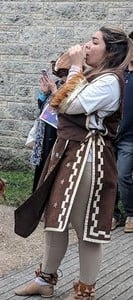 musicians, and elders who participate in it. Its roots go back to a type of widespread medieval sword dance called a morisca. Originally, the dances acted out the battle between Christianity and paganism. The Spanish brought the ritual with them to the New World, where over time it incorporated Mexican, Indian, and American religious and social symbols. Most modern versions rely heavily on representations of the Virgin Mary and the Holy Cross. The dance is usually performed in connection with major liturgical feast days such as Christmas. It is often performed by twelve to eighteen dancers who represent such characters as El Monarca (Montezuma), his bride (Malinche), El Abuelo (the Grandfather), and El Toro. The principal dancers are supported by Los Capitanes and Los Matachines, groups of male dancers. Versions and meanings of the dance vary depending on the identity and traditions of the performers.
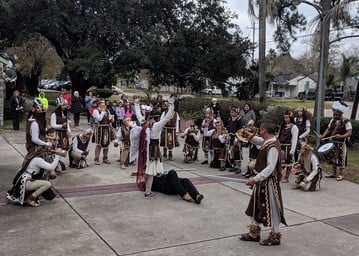
Typically, the story revolves around a young virgin, Malinche, who tries in vain to get someone to slay the bull (El Toro). El Toro, representing paganism, is eventually slain by El Monarca, who symbolizes the acceptance of Christianity. Supporting characters such as El Abuelo and La Vieja (the Old Woman) provide comic relief.
The dance is done in a series of scenes and can take an entire day to complete. The costumes vary from group to group but usually represent a mixture of Spanish, Mexican, and Indian dress. Brilliant colors and elaborate masks are common to most performances.View Video of our Matachines below
https://photos.app.goo.gl/LCkYYiDKM4abmD1AA
https://photos.google.com/share/AF1QipNYrkWP9CZE5RfR_SRagLdj5waukVnrlXAe6PyIjdUljhKUf9X4gQwdg7zYQUjaWA?key=NXZ2Z1pWdmpDRDY2VDN6ZGdBeFBGYUJHOUN2Q3BR